|
For
all of you about to
retrofit a holding
tank to comply with
regulations, or wish
to upgrade from a
less efficient
system, or
installing a system
on a new boat, how
would like to have a
system that is
self-cleaning,
self-emptying, does
not need
"Y"
valves, eliminates
the need for a
vented loop,
eliminates the need
for a macerator
pump, is easily
cleaned and flushed
and is reliable? The
KISS system allows
you to install or
retrofit the best
possible working
system without
complicated
plumbing, electrical
connections and
drilling a minimum
number of holes in
the boat.
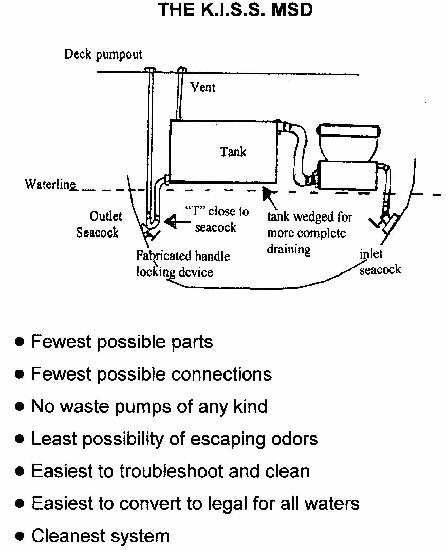
The
concept
The
concept is
simplicity itself.
The tank, installed
above the waterline,
is emptied overboard
by gravity. All
waste goes through
the tank. The toilet
pumps directly to
the top of the tank.
(MSD) there is no
"Y" valve
or any other extra
leak-prone joint in
the system. The
toilet itself can be
either manual or
electric, it makes
no difference. The
outlet at the bottom
of the tank leads to
a "Tee."
One of the fittings
goes to the seacock,
the other to the
deck pump-out
fitting. To use the
tank, you close the
seacock. To flush
straight through,
you open the seacock.
No Complicated pumps
or valves, no smelly
leaky vented loops,
yards less of
piping, dozens less
hose clamps and no
electrical
connections
necessary.
The
K.I.S.S. system is
elementary. The
toilet pumps the
waste up above the
waterline into the
holding tank.
Gravity pulls it
out. Simply by
closing the outlet
seacock, the holding
tank is in use. If
your are emptying it
offshore, you just
open the seacock and
it drains out by
itself. To rinse,
just pump the head.
Another
important aspect to
this system is that
the tank is higher
than most,
especially those way
down in the bilge,
thus reducing the
amount of
"head"
(suction) needed to
pump the tank from
dockside pump-out
facilities. By
reducing the vacuum,
the tank and hoses
will last
considerably longer
and be less prone to
operational failure.
Installation
1.
Since the toilet
discharge will be
anti-siphon
protected, it can be
located anywhere,
either above or
below the waterline.
However, to mount
below the waterline,
you must have a
positive shut-off
for incoming water.
Not all commercial
toilets are so
equipped thus the
possibility of
requiring an
anti-siphon valve in
the inlet line*
2.
The tank must be
secured above the
waterline. In the
case of a monohull
sailboat, figure the
top of the tank must
be safely above the
heeled waterline,
the bottom must be
above the upright
waterline. The
bridgedeck of a
multihull makes an
ideal location for a
tank. Most
catamarans and many
trimarans have space
in lockers in the
foredeck area that
are above the
waterline that
normally are not
easily accessible
but are close to the
boat centerline.
3.
It is important to
place the deck
clean-out line
"Tee" as
close to the outlet
seacock as possible.
This will leave the
least amount of
waste not pumped
from your deck
pump-out facility.
It is imperative to
use high quality
hose that will not
collapse under
suction. The very
best product for
this job is regular
schedule 40 PVC
pipe. Use a minimum
of short hose
lengths where there
is the possibility
of twisting or
wracking from hull
movement. Remember,
hundreds of
thousands of RV
units are plumbed
this way, dump by
gravity and have
little or no
vibration failures.
4.
With any holding
tank system it is
vital to keep the
vent pipe clear. If
the vent pipe is not
clear, it is
possible to build up
pressure in the tank
and either rupture
the tank or blow the
hoses off. In either
event, a great
unpleasantness will
ensue. Therefore, do
not use the cheap
clear vinyl tubing.
Use a high grade,
thick wall,
reinforced tubing.
All tubing should be
opaque. Letting
sunlight get into
the lines allows the
algae to grow that
causes a most
unpleasant odor.
Have
the vent so located
that you can blast
the wash hose down
it occasionally to
keep it clean.
Bigger is better.
Most successful
installation use 1
1/4" vents.
Fresh air must get
into the tank as
well as fumes
getting out. Several
catamaran
manufacturers have
the vent under the
boat between the
hulls. Install the
vent pipe free of
severe bends. Many
installations
require two vent
pipes.
Tanks
The
very best tanks will
be polypropylene and
have a hemispherical
bottom. The drain
hole will be in the
center, thus making
it close to
impossible to leave
any residue in the
tank.
The
next best, will be a
polypropylene tank
with the drain on
the bottom and the
most likely
candidate will be a
tank picked at an RV
store that has the
outlet at the lower
edge of one side. In
any event, it is
necessary to have
the inlet in the
very top.
The
tank inlet from the
toilet must be at
the very top. The
waste must free-fall
to the bottom of the
tank, leaving the
top open to continue
its secondary
function as a vacuum
break .
Tank
size and shape.
Free
surface water is
consideration. A
low, flat tank, with
a lot of surface
area, can create a
wave problem in a
partially filled
tank. If you
purchase from marine
sources, they may
provide you with
baffled tanks when
you get to that
large a size. If you
use tall skinny
cylindrical tanks,
standing on end, you
need not worry about
free surface water
and will have the
most satisfactory
shape. Even standing
a rectangular tank
on end will make a
difference. It is
important to be
creative in your
choice of tank and
location. A tank
standing on end
could be installed
in a large chain
locker or hanging
locker, perhaps
directly above the
outlet seacock.
Gauging
the size of your
tank.
The
holding tank should
be sized by how you
expect to use it. If
you are going to
spend the better
part of your
cruising at marinas,
and you will be most
often be getting
pumped out from your
deck fitting,
install the largest
practical tank. If
you are going to
spend most of your
time in waters where
you will be mostly
pumping straight
through, a small
tank will suffice.
Small is about ten
to fifteen gallons,
large is 25 gallons
and above. Rubber
tanks will also
work, but they are
much harder to clean
and flush and more
likely to smell. If
you figure a minimum
required capacity of
one half-gallon per
day per person, you
will be close to
your requirements
for size.
If
you have a deck wash
pump and hose,
flushing through the
vent is possible and
practical. Just open
the seacock, stick
the hose in the vent
pipe and fire away.
Simple
is beautiful. The
KISS MSD system cuts
the cost of
installation in more
than half by
eliminating the most
expensive parts. It
makes operation
virtually foolproof.
No fancy
instructions, no
puzzling over which
way the
"Y" valve
is turned, no more
short-circuited
rusty old macerator
pumps. Elimination
of the vented loop,
a source of odor and
malfunction, is
axiomatic. The
free-flow of air
from the vent to the
tank and the open
hose in the tank at
a height
considerably above
the waterline
subsume its
function.
Parts
in a conventional
system:
(per MSD)
tank
Macerator-pump
2
"Y" valves
1
Electrical switch
and wiring for
macerator pump
1
vented loop
1
outlet seacock (some
configurations
require TWO outlet
seacocks, another
big hole in your
hull!)
1
inlet seacock
1
"Tee"
fitting (or two,
depending upon
configuration)
hose
clamps on estimated
22 joints double
clamped where
feasible
hose
clamps for vent
double clamped
Vent
fitting
deck
pump-out fitting
Yards
of hose or PVC pipe.
Parts
in a K.I.S.S. system
(per MSD)
1
tank
1
outlet seacock
1
inlet seacock
1
"Tee"
fitting
hose
clamps on minimum
number of joints,
double clamped where
feasible
hose
clamps for vent
double clamped where
feasible
Vent
fitting
Feet
of hose or PVC pipe
*The
use of fresh water
for flushing may
modify that
requirement.
Suggestions
for making any
system work better.
1.
If you have a
watermaker or spend
considerable time at
marinas where you
can obtain water
easily, plumb your
system to flush with
fresh water. You can
have a switch over
to sea water if you
like, as a standby.
Using potable water
as flush water will
eliminate most of
the maintenance
problems associated
with marine toilets.
2.
Make sure your tank
is empty when you
leave the boat for
an extended time
period. In hot
weather, the
material may dry up
and cake, causing
serious blockage
problems. The more
complex the system,
the worse the
problems. On systems
that isolate the
holding tank from
the rest of the
system with
"Y"
valves, this can be
especially bad
because of the
tendency to neglect
the tank anyway.
In
cold weather, there
is the possibility
of freezing and
rupturing both tank
and hose. Many an
owner has come back
to spring
commissioning only
to find a split hose
or fitting due to
the nature of his
installation.
3.
There are certain
marine jurisdictions
that do not allow
any connections for
overboard flushing,
even if they are
sealed and locked.
The KISS system is
the simplest to
convert. Just remove
the "T"
from the system and
replace it with a
sweep elbow. You
then have a classic
pump out only
system. (Many
cruisers use that
most simple system
and pump out with a
hand operated
diaphragm pump from
the same deck
fitting when it is
convenient for the
to do so)
4.
Always rinse
thoroughly while you
are being pumped out
at pump-out station.
|