Divers Can Net Cash and Prizes for Bagging Lionfish
The popular aquarium fish is a voracious, non-native invader.
Posted Sunday, August 19, 2012
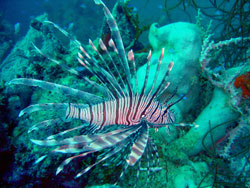


FLORIDA KEYS — Divers planning trips to enjoy the Florida Keys’ living coral barrier reef also can help protect it and give back to the environment by capturing and removing non-native lionfish from Keys waters while vacationing.
REEF runs workshops educating divers about safe collection and removal techniques, and sponsors monthly contests open to individuals and businesses that award prizes to those that catch the most lionfish.
There is no season for capturing lionfish. They can be caught anytime, anywhere and at any size. The Indo-Pacific red lionfish consumes a wide variety of prey such as invertebrates, juvenile grouper and snapper that commercial fishermen rely on. The voracious invaders, whose population is growing rapidly in Atlantic waters, outcompete native fish for food and territory. Lionfish have no natural reef predators except humans.
Divers can learn how to collect, clean and fillet this delicious fish whose delicate white meat is likened to snapper, grouper and hogfish. Although lionfish are equipped with venomous spines that are removed before cooking, the flesh has no poison.
Several Keys restaurants have adopted an “eat them to beat them” campaign and feature lionfish as a regular tasty menu item.
In addition to monthly contests, REEF also is sponsoring a series of one-day derbies throughout South Florida including an event Saturday, Sept. 8, at Coconuts Restaurant, located at mile marker 100 in Key Largo.
Derby divers can compete for more than $3,000 in prize money while helping preserve Florida Keys habitats and ecosystems. Teams of up to four people can register. Early registration fee is $100 and includes one pair of puncture-resistant gloves per team. Divers can participate in a derby from their own private vessel or join a professional dive operator’s charter.
Information and registration: www.reef.org/lionfish/derbies or 305-852-0030
http://www.flickr.com//photos/myfwcmedia/sets/72157631003581858/show/
The Florida Fish and Wildlife Conservation Commission (FWC) announced changes to the lionfish harvest at a media event on August 13th in Coral Gables. Harvesting invasive lionfish no longer will require a fishing license when using certain gear, and there is no recreational or commercial bag limit.
The FWC is taking these actions to encourage more Floridians and visitors to harvest lionfish.
“The Florida Fish and Wildlife Conservation Commission hopes that by increasing the opportunity for people to harvest invasive lionfish, we can limit the impact this nonnative invasive species has on Florida’s marine fish and wildlife,” said Jessica McCawley, director of the FWC’s Division of Marine Fisheries Management. “We also want to express our gratitude to everyone, especially divers, who already go out on a regular basis to harvest lionfish.”
The changes, enacted by an executive order, apply only through August 2013. They are:
- A recreational fishing license is not required to target lionfish while using a pole spear, a Hawaiian sling (picture included in photo set), a handheld net or any spearing device that is specifically designed and marketed exclusively for lionfish.
- There is no recreational or commercial harvest bag limit for lionfish.
Lionfish are a nonnative invasive species that threatens Florida’s saltwater fish and wildlife. They prey on native fish and wildlife and can reduce native populations. Lionfish also compete for food with native predatory fish such as grouper and snapper. The FWC encourages people to remove lionfish in Florida waters to limit negative impacts to native fish and wildlife.
Lionfish have venomous spines, so the FWC urges careful handling. Unless a person is allergic to the venom, lionfish stings are rarely fatal. Anyone getting stung should immerse the wound in hot (not scalding) water or apply heat to the affected area for 30 to 90 minutes to help break down the toxin. Also, seek medical attention as soon as possible.
Spearfishers should also take care not to damage the important reef habitat where lionfish often are found.
More information regarding lionfish is available at MyFWC.com/Fishing and clicking on “Saltwater Fishing,” “Recreational Regulations,” then “Lionfish.” To view the executive order, visit MyFWC.com/About and click on “Executive Director” then “Executive Orders.”
The 2014 recreational sport season is July 30 & 31
Find out where the fish are running with our weekly fishing reports from the Florida Keys.
It's Catch and Release Time for lots of Snook in South Florida
Safety tips to remember before and during a dive
Suspects potentially face 468 misdemeanor counts of illegal possession, among other charges.
Contact ~ About ~ Advertise ~ Privacy Policy ~ FAQ
Toll free 1-877-228-1569 ~ In South Florida 786-525-3545
Copyright© 1999 - 2015 Atlantic Coast Boating

SailMiami.com